
Written by Dr. Hubbard, NDYou know insulin resistance matters for weight. Your doctor has probably mentioned it in the context of diabetes risk or told you to lose weight to improve your insulin sensitivity. You've heard it affects metabolism, energy, and how your body stores fat.
What nobody's telling you is that insulin resistance fundamentally changes your cellular environment in ways that affect cancer risk, particularly breast cancer.
Here's the mechanism that's rarely explained: insulin isn't just a blood sugar regulating hormone. It's a growth signal. When insulin is chronically elevated (which happens with insulin resistance), it tells cells to grow, proliferate, and resist normal cell death signals. It activates pathways that promote inflammation and angiogenesis (new blood vessel formation that feeds growing tissues). It increases production of growth factors like IGF-1 (insulin-like growth factor 1), which directly stimulates cell division (1).
In a metabolically healthy woman, insulin spikes briefly after meals, does its job of shuttling glucose into cells, then returns to baseline. But in insulin resistance, insulin stays elevated for hours after eating and baseline levels creep higher over time. Your cells are bathed in growth signals continuously.
At the same time, insulin resistance increases inflammation throughout the body. Inflammatory cytokines create an environment where cells are more likely to develop DNA damage, less likely to repair that damage properly, and more likely to survive when they should be eliminated through normal cell death processes.
And critically for breast cancer specifically, insulin resistance increases estrogen production. Fat tissue (especially visceral fat that accumulates with insulin resistance) produces estrogen through an enzyme called aromatase. More insulin resistance means more visceral fat means more estrogen production. Excess estrogen, particularly when it's not being metabolized properly by an overwhelmed liver, creates additional growth signals for breast tissue (2).
I'm not sharing this to create fear. I'm sharing this because insulin resistance is measurable, identifiable, and reversible. Understanding this connection gives you agency to change your cellular environment before problems develop.
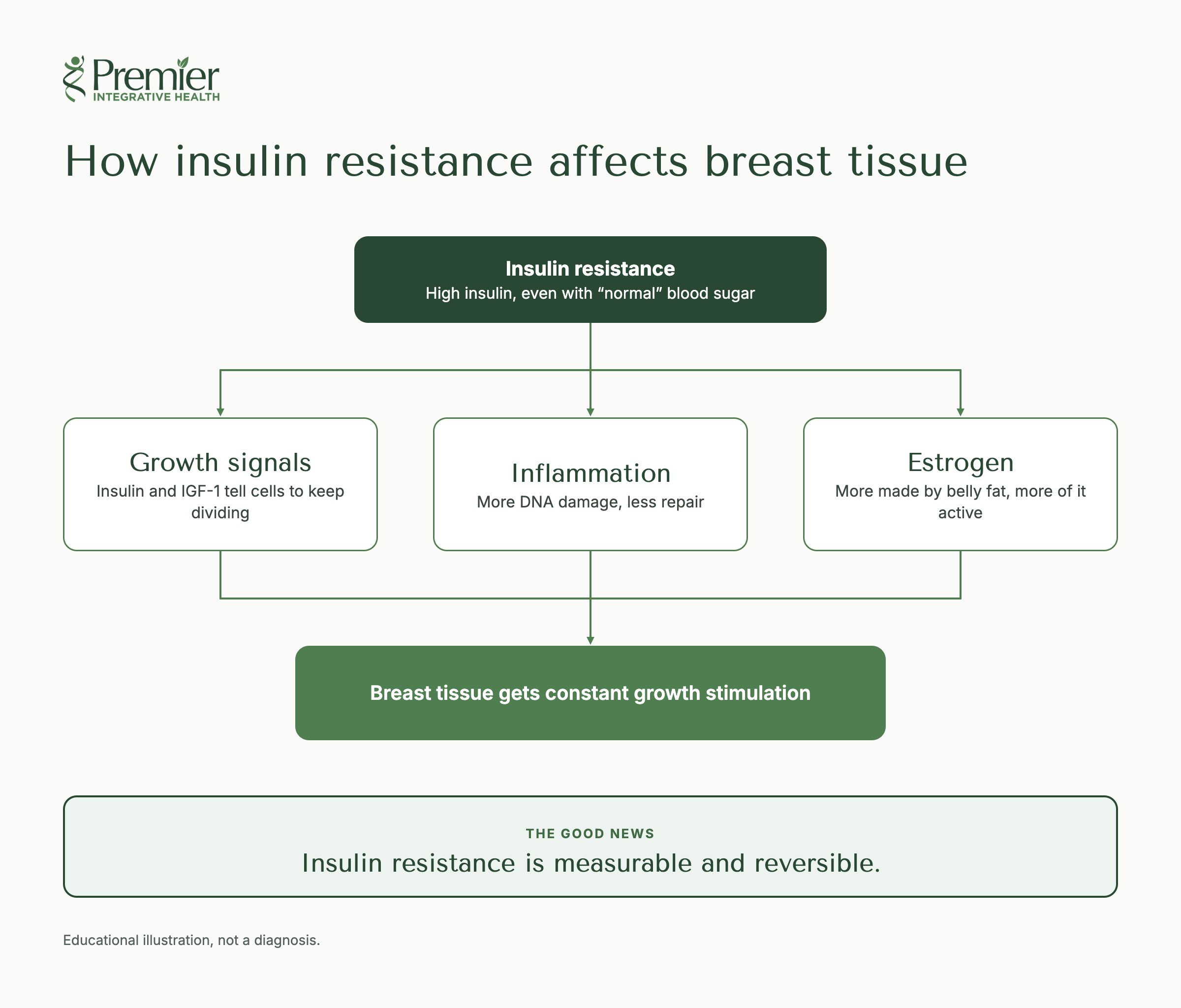
The Insulin-IGF-1 Pathway That Promotes Cell Growth
Insulin and IGF-1 are closely related hormones that share signaling pathways. When insulin is chronically elevated, IGF-1 production increases. IGF-1 binds to receptors on cell surfaces and activates pathways (particularly PI3K/AKT and MAPK) that tell cells to grow, divide, and resist death signals.
In normal physiology, this is appropriate. You need cells to grow and divide for wound healing, tissue repair, and normal turnover. But when these growth signals are constantly active (from chronically elevated insulin and IGF-1), cells receive continuous instructions to proliferate.
Breast tissue is particularly sensitive to IGF-1 signaling. Breast cells have abundant IGF-1 receptors, and when these receptors are constantly activated by elevated IGF-1, the tissue receives persistent growth stimulation. Studies consistently show that women with higher circulating IGF-1 levels have increased breast cancer risk, and that insulin resistance (which drives IGF-1 production) correlates with this elevation (3).
The stubborn weight gain and inability to lose fat despite calorie restriction that characterizes insulin resistance is the same metabolic dysfunction creating this problematic cellular environment. The body that's resistant to insulin's metabolic signals (glucose uptake into muscle and liver) is still responsive to insulin's growth-promoting signals. You get the worst of both worlds: impaired metabolic function and enhanced growth signaling.
The visceral fat that accumulates around your midsection with insulin resistance isn't just cosmetically problematic. It's metabolically active tissue that produces inflammatory cytokines and estrogen, both of which further increase breast cancer risk. The more visceral fat you have, the higher your inflammatory markers, and the more estrogen you're producing independent of ovarian function.
Insulin resistance creates chronic low-grade inflammation throughout the body. This inflammation isn't dramatic like an infection or injury. It's subtle, systemic, and persistent. But this chronic inflammatory state has profound effects on cellular health.
Inflammatory cytokines (IL-6, TNF-alpha, IL-1β) create oxidative stress, which damages cellular structures including DNA. When DNA is damaged, cells are supposed to either repair the damage or undergo apoptosis (programmed cell death) to prevent the damaged DNA from being replicated. But the same inflammatory environment that's causing DNA damage also impairs these protective mechanisms.
Inflammation activates transcription factors like NF-κB that promote cell survival and proliferation even when DNA damage is present. Cells that should be eliminated persist and continue dividing despite carrying genetic errors. Over time, this increases the likelihood that cells will accumulate enough mutations to become cancerous (4).
The 3pm energy crash that's so common with insulin resistance isn't just about blood sugar fluctuations. It reflects the inflammatory and metabolic dysfunction occurring at the cellular level. When inflammation is high and mitochondrial function is impaired (which happens with insulin resistance), energy production is inefficient. You feel exhausted because your cells literally can't produce energy efficiently.
That same mitochondrial dysfunction that's making you tired is also affecting how cells respond to growth signals and how they repair DNA damage. Healthy mitochondria aren't just energy producers; they're involved in regulating cell death pathways. Dysfunctional mitochondria allow damaged cells to survive when they shouldn't.
The Estrogen Connection Nobody Mentions
Breast cancer is often described as hormone-driven, meaning estrogen and progesterone affect cancer cell growth. But what's rarely explained is that insulin resistance fundamentally changes your estrogen environment in multiple ways.
First, insulin resistance increases aromatase activity in fat tissue. Aromatase converts androgens into estrogen. The more visceral fat you have, the more aromatase activity, the more estrogen production. Postmenopausal women are particularly affected because once ovarian estrogen production declines, fat tissue becomes the primary source of estrogen. Insulin-resistant postmenopausal women can have significantly elevated estrogen levels from fat tissue production alone.
Second, insulin resistance affects how estrogen is metabolized. The liver metabolizes estrogen through various pathways, producing different metabolites. Some are protective (2-hydroxyestrone), others are inflammatory and potentially carcinogenic (16-alpha-hydroxyestrone, 4-hydroxyestrone). Insulin resistance, which often coexists with fatty liver and impaired liver detoxification, shifts estrogen metabolism toward the problematic pathways (5).
Third, insulin resistance lowers sex hormone binding globulin (SHBG), which is the protein that binds to estrogen and testosterone in the bloodstream. When SHBG is low, more estrogen circulates in free (unbound) form. Free estrogen is the biologically active form that can bind to receptors and exert effects on tissues. So even if total estrogen isn't dramatically elevated, the amount of free estrogen available to stimulate breast tissue is higher.
The combination of increased estrogen production, shifted metabolism toward inflammatory metabolites, and higher free estrogen creates an environment where breast tissue receives excessive growth stimulation. Add the insulin and IGF-1 signaling on top of that, and you have multiple converging pathways all promoting cellular proliferation.
Why "Normal" Blood Sugar Doesn't Mean You're Safe
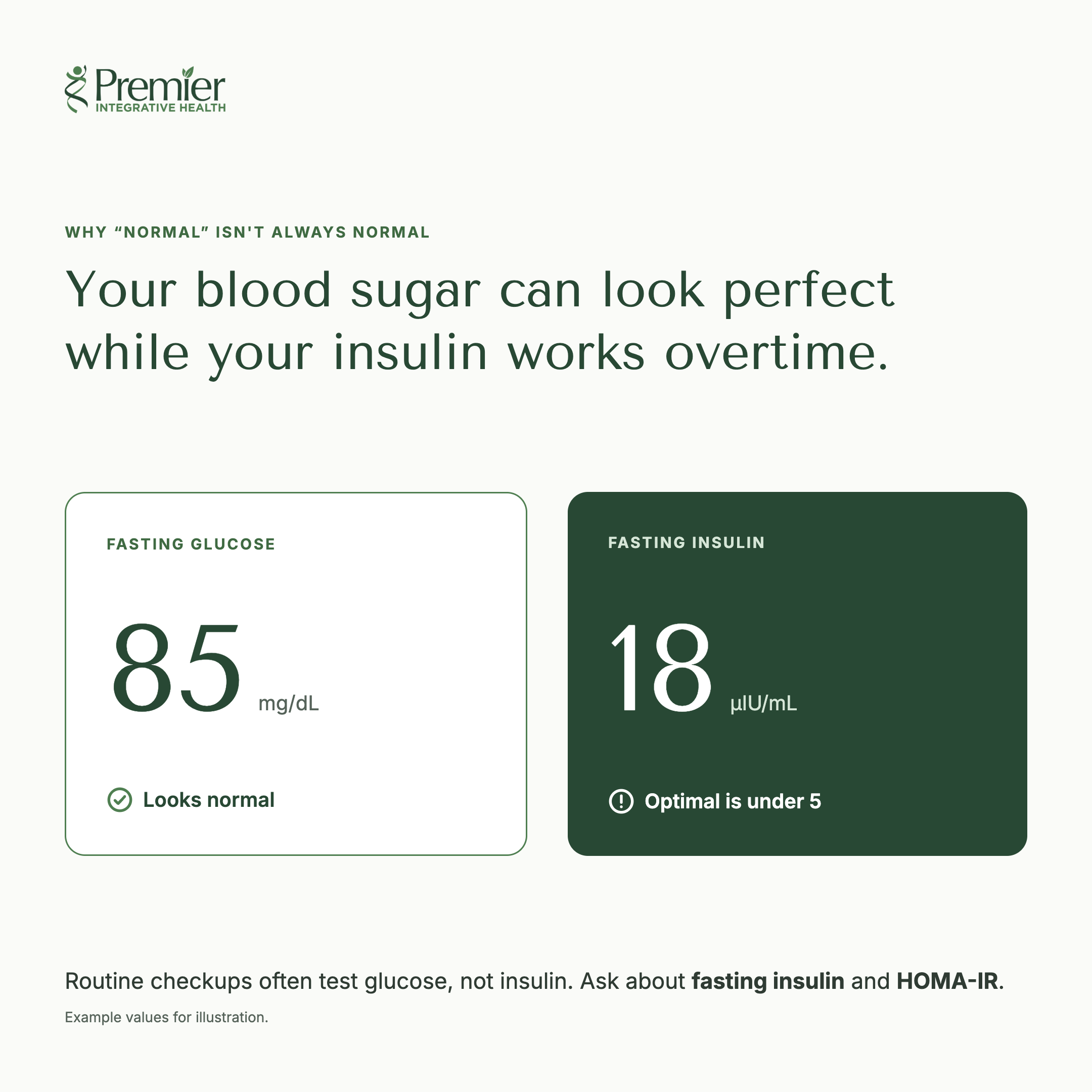
Most women who have insulin resistance don't know it because their fasting blood sugar is normal. Standard medical testing checks fasting glucose and maybe HbA1c. If these are in the normal range (fasting glucose under 100 mg/dL, HbA1c under 5.7%), you're told your blood sugar is fine and insulin resistance is ruled out.
But insulin resistance develops years before blood sugar becomes abnormal. In the early stages, your pancreas compensates by producing more and more insulin to keep blood sugar in the normal range. Your fasting glucose might be 85, which looks great. But your fasting insulin might be 15 or 20 (when optimal is under 5), indicating that your pancreas is working overtime to maintain that normal glucose.
This is the stage where the cancer-promoting effects of insulin resistance are already active. Your insulin is elevated. Your IGF-1 is elevated. Your inflammatory markers are climbing. Your visceral fat is accumulating. Your estrogen environment is shifting. But because your glucose is "normal," the problem goes undetected.
The cravings, particularly for sweets or carbs in the afternoon, are a direct signal of insulin resistance. Your cells aren't taking up glucose efficiently despite high insulin, so your brain perceives inadequate fuel availability and triggers hunger and cravings, especially for quick-energy foods. You're not lacking willpower. Your metabolic signaling is dysfunctional.
The poor sleep that often accompanies insulin resistance compounds the problem. Sleep disruption increases insulin resistance, increases inflammation, increases cortisol (which further worsens insulin resistance), and impairs the cellular repair processes that happen during deep sleep. You're creating a vicious cycle where insulin resistance impairs sleep, and poor sleep worsens insulin resistance.
The Postmenopausal Risk That Accelerates
Breast cancer risk increases significantly after menopause, and insulin resistance is a major reason why. Before menopause, the ovaries produce most of your estrogen in a cyclic, regulated pattern. After menopause, estrogen production shifts primarily to fat tissue through aromatase activity.
Women who are insulin resistant going into menopause suddenly have unregulated estrogen production that's directly proportional to their visceral fat mass and aromatase activity. There's no longer the cyclical rise and fall of estrogen that characterized their reproductive years. Instead, there's continuous estrogen production from fat tissue, and the amount depends on how much visceral fat they have.
Additionally, postmenopausal women are more likely to gain weight and become more insulin resistant due to declining metabolic rate, changing activity levels, and hormonal shifts that affect how the body stores fat. The combination of worsening insulin resistance and shifting to fat-tissue-derived estrogen production creates a particularly problematic metabolic environment for breast tissue.
Studies consistently show that insulin resistance and metabolic syndrome are more strongly associated with breast cancer risk in postmenopausal women than in premenopausal women. The risk isn't absolute, but the correlation is clear and significant enough that addressing insulin resistance should be considered a protective strategy (6).
The stubborn weight gain that so many women experience in perimenopause and after menopause isn't just about calories or hormones in isolation. It's about insulin resistance worsening as estrogen and progesterone decline, creating a metabolic state where fat accumulation (particularly visceral fat) is favored, and that fat accumulation then produces more estrogen and inflammation in an unregulated way.
What Actually Needs to Be Assessed
When someone comes to me concerned about insulin resistance and wanting to understand their personal risk, I need to assess metabolic function comprehensively, not just check fasting glucose.
That means looking at:
Fasting insulin and fasting glucose together to calculate HOMA-IR (Homeostatic Model Assessment of Insulin Resistance). This reveals insulin resistance even when glucose is normal. A HOMA-IR above 2 indicates insulin resistance is present. Fasting insulin above 5 is concerning even if glucose is normal.
HbA1c to see average blood sugar over three months, but understanding that this can be normal even when insulin resistance is significant.
Lipid panel with attention to triglycerides and HDL ratio. Insulin resistance creates a specific pattern: elevated triglycerides (above 100) and low HDL (below 50 for women). A triglyceride-to-HDL ratio above 2 is a strong marker of insulin resistance.
Inflammatory markers including high-sensitivity CRP and, if available, inflammatory cytokines. These reveal the inflammatory environment that insulin resistance creates.
Hormone panel including estrogen, progesterone (if premenopausal), testosterone, and SHBG. Low SHBG (below 40) indicates insulin resistance is affecting hormone binding and increasing free hormone levels.
Body composition assessment to measure visceral fat specifically, not just total weight or BMI. Visceral fat is the metabolically active fat that produces inflammatory cytokines and estrogen.
Liver function markers because fatty liver often coexists with insulin resistance and affects estrogen metabolism, compounding the problematic hormone environment.
Continuous glucose monitoring can be valuable to see postprandial glucose patterns and how blood sugar responds to meals throughout the day, revealing insulin resistance that fasting labs miss.
But beyond labs, I'm listening to symptoms. Stubborn weight gain (especially around the midsection), intense cravings for carbs or sweets, energy crashes in the afternoon, difficulty losing weight despite calorie restriction, and poor sleep all point to insulin resistance even before labs are dramatically abnormal.
How We Actually Reverse Insulin Resistance
The critical point: insulin resistance is reversible. The metabolic and inflammatory environment it creates can be changed. You're not stuck with elevated cancer risk because of your current metabolic state.
The intervention to reverse insulin resistance is multifaceted:
Dietary changes that stabilize blood sugar and reduce insulin demand: prioritizing protein and healthy fats, reducing refined carbohydrates and sugars, timing carbohydrate intake strategically (earlier in the day when insulin sensitivity is higher), and ensuring adequate fiber to slow glucose absorption.
Exercise, particularly resistance training and high-intensity interval training, which directly improves insulin sensitivity in muscle tissue. Muscle is the primary site of glucose disposal, and when muscle cells become more insulin sensitive, less insulin is required to handle dietary glucose.
Sleep optimization because sleep deprivation worsens insulin resistance significantly. Ensuring 7-8 hours of quality sleep, addressing sleep apnea if present, and maintaining consistent sleep-wake times all improve insulin sensitivity.
Stress management because chronic stress elevates cortisol, which directly promotes insulin resistance. Nervous system regulation practices, adequate rest, and addressing chronic stressors are essential.
Targeted supplements that improve insulin sensitivity: berberine, inositol (particularly myo-inositol), alpha-lipoic acid, chromium, and magnesium all have evidence for improving insulin sensitivity when combined with lifestyle changes.
Reducing visceral fat through the above interventions. As visceral fat decreases, inflammation decreases, aromatase activity decreases, and the metabolic environment improves.
Addressing any underlying gut dysfunction, because gut inflammation and endotoxin (LPS) from intestinal permeability drive systemic inflammation that worsens insulin resistance.
Supporting liver function and estrogen detoxification to improve how estrogen is metabolized and eliminated, reducing the burden of inflammatory estrogen metabolites.
The goal isn't just weight loss (though that often happens as insulin sensitivity improves). The goal is changing the cellular environment from one that promotes growth, inflammation, and cellular dysfunction to one that supports normal cell regulation, DNA repair, and appropriate cell death when damage occurs.
What Happens When Insulin Sensitivity Is Restored
When insulin sensitivity improves, the changes are both felt and measurable.
Energy stabilizes throughout the day. The 3pm crash disappears because blood sugar regulation normalizes and mitochondrial function improves.
Cravings decrease dramatically or disappear. When cells can take up glucose efficiently, the brain doesn't trigger constant hunger and carb cravings.
Weight loss becomes possible, particularly from the midsection. Visceral fat decreases as insulin levels normalize and the body can access stored fat for energy again.
Sleep often improves significantly because the metabolic dysfunction that was disrupting sleep architecture resolves.
Inflammatory markers decrease measurably on lab testing. CRP drops, cytokine levels normalize.
Hormone environment improves. Estrogen production from fat tissue decreases as visceral fat decreases. SHBG rises, meaning less free estrogen is circulating. Liver function improves, meaning estrogen is metabolized more efficiently.
Insulin and IGF-1 levels normalize, removing the constant growth signaling that was affecting cellular behavior.
But more than any single marker, the cellular environment shifts from one that favors proliferation and dysfunction to one that supports normal cellular regulation and health. You're changing your terrain at the most fundamental level.
Let's Assess Your Metabolic Risk
If you’re recognizing yourself in these patterns (stubborn weight especially around your middle, afternoon crashes, intense cravings, poor sleep, difficulty losing weight despite effort), you need to understand your insulin resistance status and what it means for your long-term health, not just your weight.
The first step is a free 20-minute discovery call with a member of our team. On this call, we’ll talk through your main symptoms, your health history and what you’ve already tried, and answer your questions about how we work. It’s a chance to see whether our approach is the right fit for what you’re experiencing.
If it looks like a good fit, the next step is a Care Partnership Evaluation with me. This is a deeper, 45 to 60 minute paid consultation where we:
Walk through your complete metabolic symptom pattern, weight history, family history of diabetes and cancer, and the lifestyle factors affecting your insulin sensitivity.
Review any metabolic testing you’ve already had. Most women have had fasting glucose checked and been told they’re fine, but that alone can’t assess insulin resistance or the inflammatory and hormonal environment it creates.
Identify which specific tests would reveal your insulin resistance status, inflammatory burden and hormone environment.
Decide together whether we’re a good fit to move forward, and what a personalized plan could look like.
If you’re ready to understand your metabolic health beyond blood sugar and weight, you can schedule your free discovery call here.
Insulin resistance isn’t just about weight or diabetes risk. It’s about the cellular environment you’re creating every day through your metabolic function. That environment either supports health or creates terrain where dysfunction can develop. Let’s optimize yours.
References:
Gallagher EJ, LeRoith D. Obesity and diabetes: the increased risk of cancer and cancer-related mortality. Physiol Rev. 2015;95(3):727-748. doi:10.1152/physrev.00030.2014
Arcidiacono B, Iiritano S, Nocera A, et al. Insulin resistance and cancer risk: an overview of the pathogenetic mechanisms. Exp Diabetes Res. 2012;2012:789174. doi:10.1155/2012/789174
Goodwin PJ, Ennis M, Pritchard KI, et al. Insulin-like growth factor binding proteins 1 and 3 and breast cancer outcomes. Breast Cancer Res Treat. 2002;74(1):65-76. doi:10.1023/a:1016075322156 [Note: This is older than 10 years. For more recent: Christopoulos PF, Msaouel P, Koutsilieris M. The role of the insulin-like growth factor-1 system in breast cancer. Mol Cancer. 2015;14:43. doi:10.1186/s12943-015-0291-7]
Giovannucci E, Harlan DM, Archer MC, et al. Diabetes and cancer: a consensus report. Diabetes Care. 2010;33(7):1674-1685. doi:10.2337/dc10-0666 [Note: This is 2010, just at the edge of 10 years. For more recent: Orgel E, Mittelman SD. The links between insulin resistance, diabetes, and cancer. Curr Diab Rep. 2013;13(2):213-222. doi:10.1007/s11892-012-0356-6]
Ferguson LR, Chen H, Collins AR, et al. Genomic instability in human cancer: molecular insights and opportunities for therapeutic attack and prevention through diet and nutrition. Semin Cancer Biol. 2015;35 Suppl:S5-S24. doi:10.1016/j.semcancer.2015.03.005
Esposito K, Chiodini P, Capuano A, et al. Metabolic syndrome and postmenopausal breast cancer: systematic review and meta-analysis. Menopause. 2013;20(12):1301-1309. doi:10.1097/GME.0b013e31828ce95d
